
Vietnam has introduced new rules for determining whether products manufactured and circulated domestically qualify as Vietnamese-origin goods. Effective January 1, 2027, Decree No. 384/2026/ND-CP establishes clearer origin criteria, including a minimum Vietnamese Value Content (VVC) of 30% under one of the applicable rules. But does this mean every product labeled “Made in Vietnam” must contain at least 30% Vietnamese value? And what does the change mean for international buyers sourcing from Vietnam?
1. What’s Changing in Vietnam’s Rules of Origin?
On October 9, 2026, the Vietnamese government issued Decree No. 384/2026/ND-CP, which establishes criteria for determining Vietnamese origin for goods manufactured and circulated within Vietnam.
The decree takes effect on January 1, 2027.
One of its most widely discussed provisions is the minimum 30% Vietnamese Value Content (VVC) criterion for goods that are not wholly obtained in Vietnam.
For international buyers, this raises several practical questions:
- Does a product need at least 30% Vietnamese content to qualify as “Made in Vietnam”?
- Can a Vietnamese factory use imported Chinese components and still manufacture Vietnamese-origin goods?
- Will products that meet the new Vietnamese requirements automatically qualify as Vietnamese-origin goods when imported into the United States or the European Union?
The short answer is that the 30% threshold is not a universal requirement for all Made in Vietnam products, and Vietnam’s domestic origin rules do not automatically determine origin in importing countries.
Understanding this distinction is essential when evaluating Vietnamese manufacturers.
2. How Was “Made in Vietnam” Determined Before 2027?
Before the new decree, product origin labeling in Vietnam was primarily governed by Decree No. 43/2017/ND-CP, as amended by Decree No. 111/2021/ND-CP.
Under this framework, manufacturers and importers were responsible for determining and declaring product origin accurately.
Businesses were required to ensure that origin declarations were truthful and consistent with applicable legal requirements.
However, the labeling framework did not establish a single, comprehensive set of quantitative criteria specifically for determining Vietnamese origin for all goods manufactured and circulated domestically.
This sometimes created uncertainty for products manufactured in Vietnam using imported raw materials and components.
Consider an electronics manufacturer operating in Vietnam.
The factory may import printed circuit boards, electronic components and other materials from China or Taiwan while performing assembly, testing and other manufacturing operations in Vietnam.
Should the finished product be considered Vietnamese-origin?
The answer depends on the applicable origin rules and the nature of the manufacturing operations, not simply the location of the factory.
The new decree provides more explicit criteria for domestic origin determination.
3. The New Criteria: Wholly Obtained and Non-Wholly Obtained Goods
Decree No. 384/2026/ND-CP distinguishes between two broad categories of goods.
Wholly Obtained Goods
These are goods entirely obtained or produced in Vietnam under the conditions specified in the decree.
Certain agricultural products grown and harvested in Vietnam, for example, may qualify as wholly obtained Vietnamese goods.
Non-Wholly Obtained Goods
This category is particularly relevant to international buyers sourcing manufactured products.
Many Vietnamese factories rely on globally sourced materials and components.
A stainless-steel sink manufacturer may use imported stainless-steel sheets. An electrical appliance factory may import motors, switches and electronic components. A furniture producer may source certain fittings and accessories overseas.
Under the new decree, non-wholly obtained goods may qualify as Vietnamese-origin through applicable origin criteria, including:
Change in Tariff Classification (CTC)
The manufacturing process must result in the required change in tariff classification between non-originating materials and the finished product, subject to the applicable conditions.
Vietnamese Value Content (VVC)
The product must achieve a minimum Vietnamese Value Content of 30%, calculated according to the prescribed methodology.
These are alternative origin criteria under the relevant provisions, rather than a blanket requirement that every product satisfy both.
Consequently, a product with less than 30% VVC may still qualify for Vietnamese origin if it meets the applicable tariff-classification change criterion and other relevant requirements.
Manufacturing operations must also be assessed against the decree’s provisions concerning simple processing.
For buyers, this means that a product’s country of origin cannot be determined solely by calculating the percentage of imported materials.
4. How Is the 30% Vietnamese Value Content Calculated?
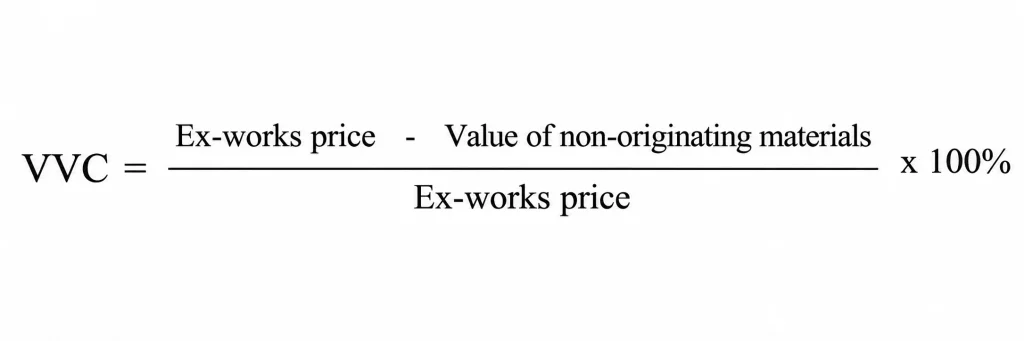
There are two ways to calculate VVC: the direct method and the indirect method.
- Direct method
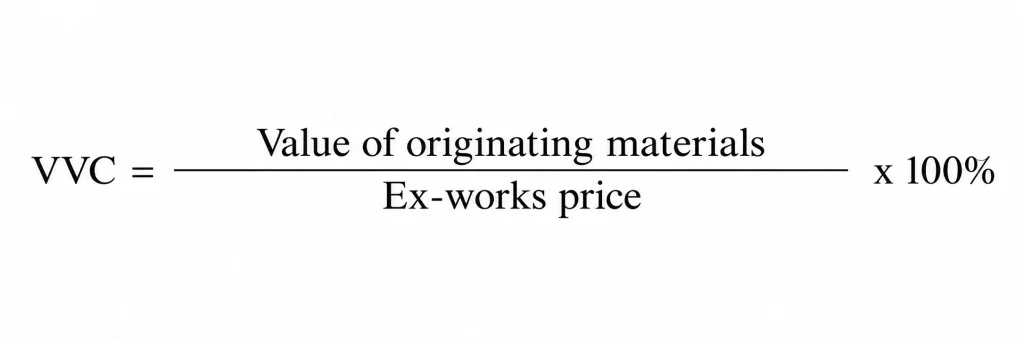
- Indirect method
Which calculation method is more advantageous for Vietnamese enterprises?
Based on a simple, universally understood calculation, a product is composed of: EXW Price (A) = Cost of materials of Vietnamese origin (B) + Cost of materials of non-originating status (C) + Other components (D, including production costs, administrative expenses, and profit).
Thus, using the direct calculation method, the result will be B/A.
However, using the indirect calculation method, the result will be (A-C)/A = (B+D)/A.
Clearly, the indirect calculation method yields a larger numerator and offers a higher probability of the VVC exceeding 30% compared to the direct calculation approach.
We would like to provide the following additional example to further clarify the matter for our readers:
Assume the following figures:
| Item | Value |
|---|---|
| Ex-works price of finished product | US$100 |
| Value of non-originating materials | US$65 |
| Remaining value | US$35 |
Using a simplified indirect calculation:
VVC = (Ex-Works Price − Value of Non-Originating Materials) / Ex-Works Price × 100%
VVC = (100 − 65) / 100 × 100% = 35%
Under these assumptions, the product meets the 30% VVC threshold.
Now suppose the value of non-originating materials increases to US$75 while the ex-works price remains US$100.
The resulting VVC would be 25%, below the threshold.
Does this automatically mean the water purifier cannot qualify as Vietnamese-origin?
Not necessarily.
The manufacturer may still need to evaluate whether the product satisfies another applicable origin criterion, such as Change in Tariff Classification.
These figures are illustrative. Actual calculations must follow the decree’s definitions and rules for material values, ex-works prices and eligible costs.
The key point for international buyers is that 30% VVC does not simply mean 30% of raw materials must be purchased from Vietnamese suppliers.
Depending on the calculation method, value generated through manufacturing activities in Vietnam may also be relevant.
Some key points to note:
- Packaging material costs are also included when calculating VVC.
- The VVC formula accounts only for raw materials (direct method); consequently, costs related to Vietnamese labor, factory depreciation, and energy expenses incurred in Vietnam are excluded from the VVC calculation.
5. Key Takeaways for International Buyers
Vietnam’s Decree No. 384/2026/ND-CP, effective January 1, 2027, introduces more explicit criteria for determining Vietnamese origin for goods manufactured and circulated domestically.
The 30% Vietnamese Value Content threshold is an important part of this framework, but it is not a universal minimum local-content requirement for every Made in Vietnam product.
Products may qualify under alternative origin criteria where applicable, including Change in Tariff Classification, subject to the decree’s other requirements.
For international buyers, the distinction between domestic Vietnamese origin rules and destination-country import rules is essential.
A Made in Vietnam label, a manufacturing address in Vietnam or a declaration of 30% Vietnamese content should not be treated as conclusive proof of origin for international customs purposes.
Instead, buyers should evaluate the actual manufacturing process, the origin of key materials and the specific rules applicable to their destination market.
As global sourcing strategies become more diversified, understanding these differences can help buyers assess Vietnamese suppliers more accurately and manage country-of-origin compliance risks.
Need Help Sourcing Products with Vietnamese Origin?
Understanding country-of-origin requirements is an important part of sourcing from Vietnam. However, finding the right manufacturer that can meet these requirements can be equally challenging.
makein.vn can help.
Whether you need guidance on Vietnam’s rules of origin or are looking for manufacturers capable of producing goods that meet applicable Vietnamese-origin requirements, our team is here to assist.
Contact makein.vn to discuss your sourcing requirements and explore potential manufacturing partners in Vietnam.
Official Sources and Further Reading
- Government of Vietnam — Decree No. 384/2026/ND-CP, issued October 9, 2026, effective January 1, 2027.
https://chinhphu.vn/?docid=219934&pageid=27160&typegroupid=4 - Government of Vietnam — Official guidance and publication of Decree No. 384/2026/ND-CP.
https://xaydungchinhsach.chinhphu.vn/quy-dinh-xac-dinh-xuat-xu-viet-nam-voi-hang-hoa-san-xuat-luu-thong-trong-nuoc-119261012093319683.htm - Decree No. 43/2017/ND-CP, as amended by Decree No. 111/2021/ND-CP, concerning goods labeling.
- Decree No. 31/2018/ND-CP, concerning rules of origin in foreign trade.
- US Customs and Border Protection (CBP) — Relevant US country-of-origin requirements and origin determinations.
- European Commission — EU rules of origin and the EU–Vietnam Free Trade Agreement.
Last updated: October 13, 2026.
Disclaimer: This article is provided for general research and informational purposes only. Origin requirements may vary by product, destination market, trade agreement and applicable customs regulations. Buyers and manufacturers should verify current legal requirements with the relevant authorities or qualified customs professionals before making commercial or compliance decisions.

Chuyên gia với 15 năm kinh nghiệm trong lĩnh vực Sales Xuất Khẩu. Tôi đồng hành cùng các doanh nghiệp Việt Nam từ các dự án MS đến OBM, từ Indonesia, Đông Âu tới thị trường Mỹ hay Argentina xa xôi.